
Learning how to assess your pet’s quality of life can help when you are wondering whether your companion is comfortable, struggling, or somewhere in between. You may notice small changes long before you know what they mean. For families searching for a veterinarian near me in Los Angeles, Edencrest Veterinary Care offers quality-of-life consultations and in-home end-of-life care. This guide explains what to observe, how to keep a useful record, and when to ask for help, so your next decision can begin with a clearer picture of your pet’s day.
How to Assess Your Pet’s Quality of Life at Home
To assess your pet’s quality of life at home, look at comfort, basic needs, movement, and enjoyment together, then discuss concerning changes with a veterinarian. The question is how your pet experiences daily life: whether resting feels comfortable, meals are manageable, and familiar activities still bring interest. Age and a diagnosis provide context, but they do not tell the whole story of a particular afternoon.
Start with the pet you know. What does a satisfying day look like for your quiet cat or sociable dog? A cat might enjoy watching birds beside you; a dog might value a brief sniff outside more than a long walk. Write down a few examples in your own words, without trying to make them sound medical.
An assessment can lead to a discussion about treatment, practical support, or end-of-life decisions. Our quality-of-life consultation information explains how to begin that conversation. You do not have to arrive with a decision already made or wait until you feel certain that something is wrong.
A Daily Checklist for Your Pet’s Comfort and Enjoyment
A daily checklist for your pet’s comfort and enjoyment should cover several parts of the day, rather than relying on one encouraging or worrying moment. AAHA’s owner guide to quality of life highlights comfort, daily function, and behavior as useful areas to discuss. The following prompts are observations to share with your veterinarian, not a way to diagnose a disease. Look for changes from your pet’s usual habits and describe what you actually see.
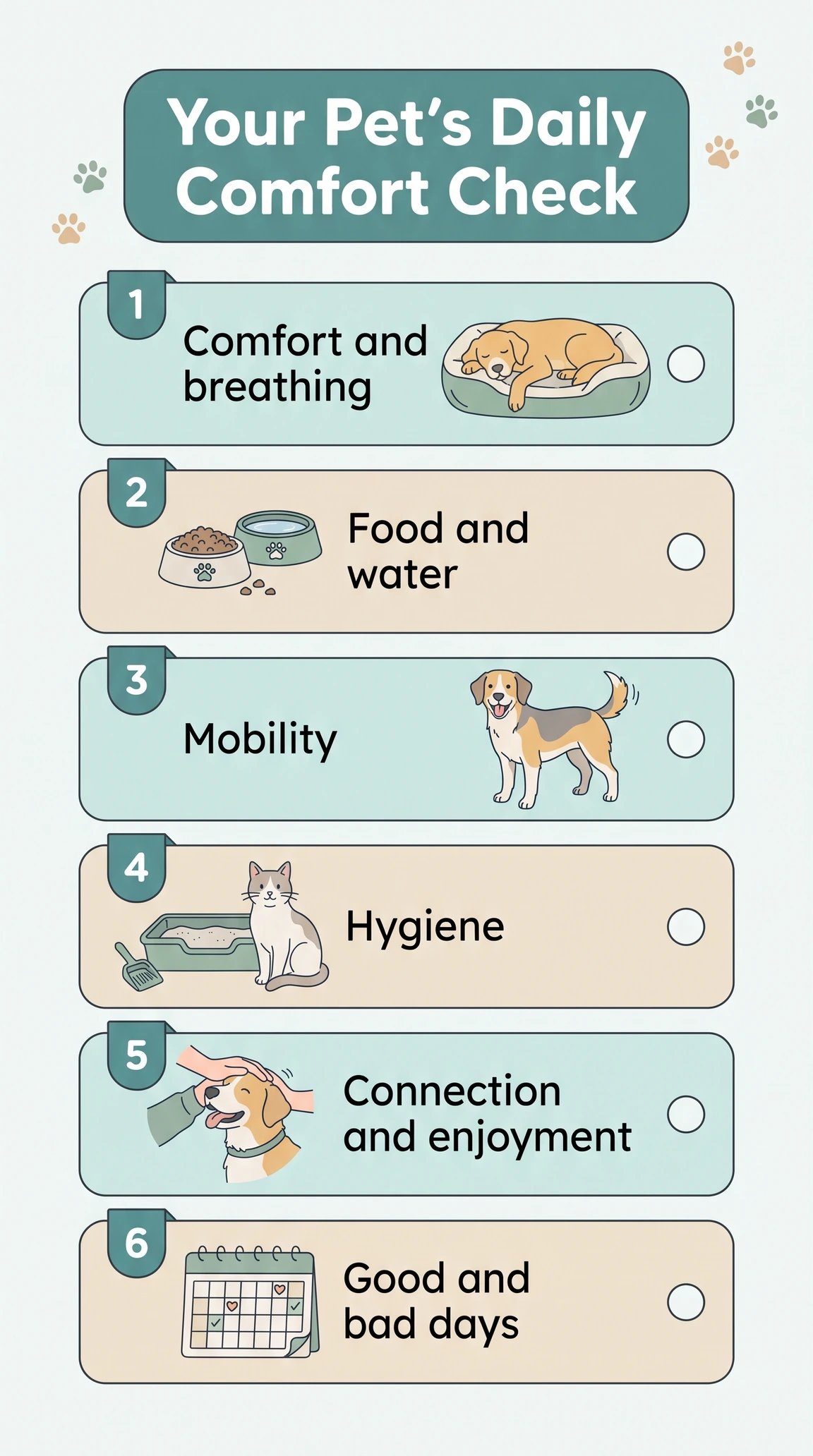
1. Comfort and Breathing
Comfort and breathing deserve attention whenever your pet is resting, moving, or being touched. Notice whether your companion can settle into a relaxed position, sleep peacefully, and rise without obvious distress. Repeated repositioning, sensitivity to touch, or unusual restlessness can be reasons to call your veterinarian. Quiet behavior does not establish that an animal is comfortable, and obvious difficulty breathing needs emergency attention. Record an observation such as “changed position repeatedly overnight” rather than assuming you know its cause.
2. Food and Water
Food and water observations should include your pet’s interest, actual intake, and any difficulty eating or drinking. Write down whether a meal was mostly eaten, barely touched, or refused, and note vomiting or a noticeable change in drinking. Eating a favorite treat is useful information, but it does not answer every question about comfort. Contact your veterinarian promptly about reduced intake or difficulty keeping food or water down, particularly when your pet is already ill. Ask for an individual plan rather than guessing how long to wait.
3. Mobility
Mobility means being able to reach important places and change position with acceptable comfort, including with appropriate support. Watch your pet get up, walk to water, and reach a toileting area. For cats, reduced jumping or difficulty entering the litter box can be meaningful changes even without an obvious limp. Ask your veterinarian about suitable support and home adjustments, such as nonslip surfaces or easier access to essentials. Needing assistance is something to assess in context, including whether that assistance is comfortable for your pet.
4. Hygiene
Hygiene includes your pet’s ability to remain clean, dry, and comfortable, independently or with tolerable help. Notice reduced grooming, soiled bedding, new accidents, or difficulty getting into position to urinate or pass stool. These changes deserve veterinary assessment rather than being dismissed as inevitable aging. Straining to urinate with little or no urine needs immediate veterinary attention. Describe how much help is needed and how your pet responds to it. An accident alone cannot tell you whether it is time to say goodbye, but repeated distress around toileting should become part of the conversation.
5. Connection and Enjoyment
Connection and enjoyment are the activities and interactions your pet still appears to welcome. Think about familiar greetings, comfortable companionship, watching the garden, or interest in a favorite toy. Observe whether your pet chooses these moments and can participate without obvious discomfort. Withdrawal or a marked change in social behavior warrants discussion with your veterinarian. Give quieter pleasures room in your notes, too: describe what your pet enjoys now without expecting the energy or preferences they had years ago.
6. Good and Bad Days
Good and bad days describe the overall balance of comfort and difficulty across time. Choose plain descriptions your family can use consistently, such as “rested comfortably and enjoyed meals” or “repeatedly unsettled and uninterested in usual activities.” Include mixed days, which may be harder to summarize. Avoid letting a single welcome moment erase the rest of a difficult day. Equally, describe setbacks accurately rather than assuming each one means a permanent decline; your veterinarian can help interpret the pattern.
How to Track Changes Without Letting a Score Decide
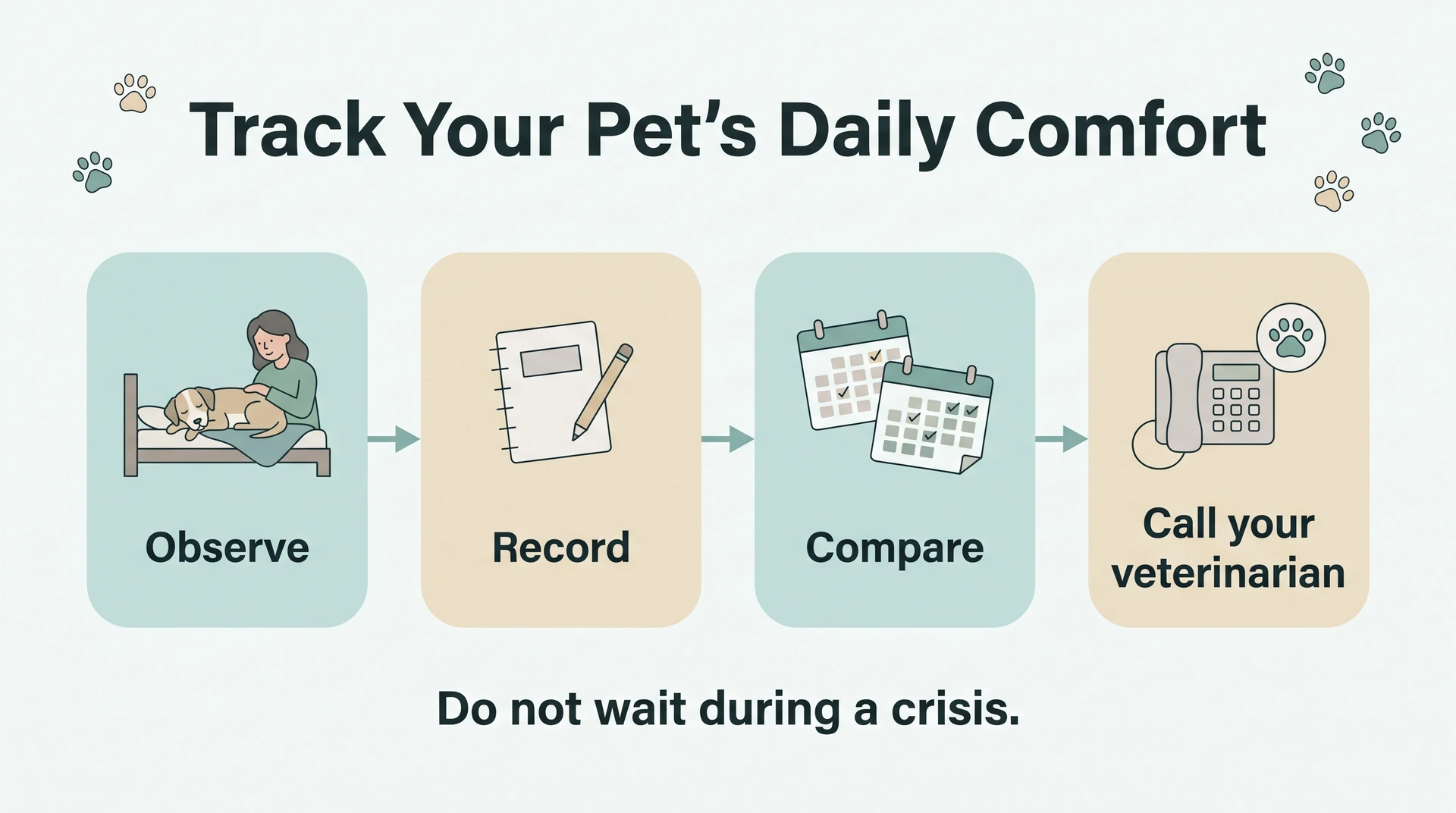
To track changes without letting a score decide, use a short daily record to organize observations and review it with your veterinarian. A notebook or phone note can hold the date, meals, rest, movement, enjoyable moments, and anything that concerned you. Include when a problem happened and whether it followed an activity or treatment. If it is safe and does not delay care, a brief video may help you show a change that is difficult to describe.
Ohio State’s How Will I Know? guide suggests identifying three to five favorite activities and tracking good and bad days. Choose activities specific enough to recognize, such as greeting your partner at the door or resting comfortably at the window. Comparing separate family members’ notes can also reveal experiences that happen at different times.
The American Animal Hospital Association’s end-of-life assessment guidance cautions that most online quality-of-life scales have not been validated. Treat a worksheet as a conversation aid, not a diagnosis or automatic instruction to choose euthanasia. A reassuring total must not override a serious problem such as severe pain or breathing distress, and you should not wait to collect several days of notes before seeking needed care.
Gradual Changes or an Emergency: When Should You Seek Help?
Seek veterinary help promptly for concerning gradual changes, and contact an emergency veterinary hospital immediately for acute distress. The University of Sydney Veterinary Teaching Hospitals’ emergency guidance identifies breathing difficulty, collapse, seizures, and severe pain among signs requiring urgent attention. An older pet or a pet with a terminal diagnosis can still experience a medical emergency.
The table below separates observations to discuss promptly from examples that need immediate emergency attention; it cannot determine the cause or urgency of every individual situation.
| What you notice | A change to discuss promptly | Seek emergency care immediately |
|---|---|---|
| Breathing | A new change from your pet’s usual breathing | Labored breathing or struggling for air |
| Movement | Increasing difficulty rising or reaching essentials | Collapse or sudden inability to stand |
| Comfort | More restlessness or reduced tolerance of touch | Severe, uncontrolled pain or obvious distress |
| Awareness | New confusion or changes in familiar behavior | An ongoing seizure, repeated seizures, or unresponsiveness |
| Eating and digestion | Reduced appetite or a change in drinking | Repeated vomiting with collapse or marked weakness |
For an emergency, call the nearest emergency veterinary hospital and arrange immediate evaluation. Do not wait for a routine consultation, an online reply, or a home euthanasia appointment. If your pet has an existing hospice plan, follow its crisis instructions and contact the treating veterinarian or designated emergency provider immediately.
Questions to Ask During a Quality-of-Life Consultation
Questions to ask during a quality-of-life consultation should connect your observations with options for comfort and a clear next step. Bring recent records if available, a medication list, your daily notes, and the changes that worry you most. You can also say what your family hopes to preserve, such as comfortable sleep, peaceful meals, or time together without repeated distress.
- What might be causing the changes we are seeing, and is further evaluation appropriate?
- Which problems may improve, and which are likely to progress?
- What would meaningful improvement look like for this particular pet?
- What signs should prompt a same-day call or emergency visit?
- How will we judge whether the burdens of treatment outweigh its benefits?
- When should we reassess, and whom should we contact if things worsen sooner?
Share practical concerns honestly, including lifting difficulties, disrupted sleep, medication struggles, finances, and the help available at home. These details help make a plan realistic. You can ask for an explanation again, request written next steps, or explain that different family members are seeing different things. A useful conversation gives you specific observations to watch for and a plan for responding to them.
When to Discuss Comfort Care and Humane Euthanasia
Discuss comfort care and humane euthanasia when symptoms are becoming harder to manage, enjoyable moments are shrinking, or you are uncertain that the current plan meets your pet’s needs. Palliative care focuses on relieving symptoms and distress and can sometimes accompany treatment of the underlying disease. Hospice adds planning and support for a pet approaching the end of life. Ask which services your treating veterinarian can provide and how changes will be reviewed.
An end-of-life conversation can happen while there are still comfortable moments. Ask about the likely course of your pet’s illness, the problems that may arise, and what can realistically be relieved. If suffering cannot be adequately controlled, humane euthanasia may be a compassionate option to discuss. Your veterinarian can help weigh the whole clinical picture alongside what you observe at home.
Learning about the process can make that discussion more concrete. Our guide to what happens during in-home euthanasia explains the visit, while our article on what to do with your dog before euthanasia addresses preparation. Reading either article does not commit you to a decision. You can gather information while continuing to ask what your pet needs today.
Booking Quality-of-Life Support in Los Angeles
Booking quality-of-life support in Los Angeles begins with explaining what you are noticing and asking which appointment fits your pet’s needs. At Edencrest Veterinary Care, we offer consultations with Dr. Jessica DiGenova, in your home or virtually. If you have searched for “pet quality-of-life consultation near me,” call or text (209) 561-5180 to discuss the next step.
If you are searching for “in-home end-of-life care near me,” check our mapped coverage before arranging a visit. Some cities are only partly covered, so confirm your address. Review our services and pricing or book an in-home euthanasia visit when you are ready. Our service provides end-of-life consultations and care; ongoing treatment and diagnostic needs should be discussed with your regular veterinarian.
Knowing how to assess your pet’s quality of life can help you explain the uncertainty you are carrying. Whether you live in Los Angeles or elsewhere, the next conversation can start with what your pet did today, what felt difficult, and what you hope could be more comfortable.
Frequently Asked Questions
The frequently asked questions below address common uncertainties about assessing comfort and planning the next conversation. Individual advice depends on your pet’s condition and examination, so use these answers to prepare questions for your veterinarian.
How to Assess Your Pet’s Quality of Life: What Should You Track Between Visits?
To assess your pet’s quality of life between vet visits, record changes in comfort, daily activities, and enjoyment. Daily notes can be useful when illness is changing your pet’s routine; ask your veterinarian how closely to monitor and when to reassess the care plan. Keep the record manageable so you can use it consistently. Report a significant change when it happens, without waiting for the next appointment if your companion seems uncomfortable or suddenly worsens.
Can My Pet Have Poor Quality of Life While Still Eating?
Your pet can have poor quality of life while still eating, because appetite is only one part of overall wellbeing. A companion may accept food while struggling with pain, movement, sleep, or other essential activities. Tell your veterinarian what your pet eats and what the rest of the day looks like. Include how much help meals require and whether your pet can settle comfortably afterward, rather than relying on food interest alone.
How Do I Assess My Cat’s Quality of Life?
Assess your cat’s quality of life by observing comfort, eating, grooming, litter box access, movement, and familiar social behavior. Changes may be subtle, such as avoiding a favorite perch or spending less time near you. Record what has changed and ask your veterinarian to evaluate possible causes. A behavior change by itself does not establish a diagnosis or mean euthanasia is necessary; it provides a reason to look more closely at your cat’s needs.
Does a Quality-of-Life Consultation Mean Choosing Euthanasia?
A quality-of-life consultation does not mean you must choose euthanasia. It is an opportunity to discuss observations, comfort, options, and uncertainty with a veterinarian. Depending on the findings, the conversation may include further assessment, changes to a care plan, or end-of-life decisions. Explain what you want help understanding when you request the appointment. You can also ask what information to bring so the discussion addresses your pet’s situation as clearly as possible.
Is a Quality-of-Life Consultation Worth Booking Before a Crisis?
A quality-of-life consultation can be worth booking before a crisis when changes or uncertainty are making daily decisions difficult. It gives you an opportunity to ask about expectations, realistic comfort goals, and signs that require faster help. Ask about the consultation fee and what the appointment includes before booking. A plan cannot prevent every emergency, but it can clarify whom to call and what to do if your pet’s condition changes.
How Do I Know When It Is Time to Say Goodbye?
Knowing when it is time to say goodbye usually requires considering your pet’s comfort, the course of their condition, and what care can realistically achieve. No single online score can make that decision for every animal. If difficult days are increasing or symptoms remain distressing despite care, ask for a direct conversation about suffering and available options. You can seek that guidance while your pet still has enjoyable moments, without waiting for a crisis.
Your pet’s comfort matters, and you deserve support as you decide how to care for them through each changing day.